What to Look for in a 510 Thread Battery: 8 Specs That Actually Matter (Plus a Dry Herb and Dab Pen Primer for New Users)
/fit-in/1024x1024/storage/images/1b01df38-bb0c.jpg)
Key Takeaways
-
Variable voltage is the spec that matters most. A battery that lets you run a cart between roughly 2.4V and 3.4V protects flavor, stretches cart life, and, per a 2021 Portland State study, produces fewer thermal degradation byproducts than running hot.
-
Safety features are not optional. A 5-click lock, a preheat mode, USB-C charging, and short-circuit and overcharge protection matter. The U.S. Fire Administration found 31% of reported e-cig battery incidents happened in a pocket and 25% during charging.
-
Look for UL 8139 certification and a warranty you'd actually use. More than half of vape owners don't know their device contains a lithium-ion cell. The brand should.
-
Match capacity to your habits. 280 to 350 mAh is plenty for a slim daily pen. Go 650 mAh or higher only if you refuse to charge every night.
-
Dry herb vaporizers and dab pens are different tools for different material. Most new users should start with a 510 battery and a lab-tested cartridge from a licensed shop, then branch out.
Most people obsess over the cartridge. Then they screw it onto whatever battery the shop had by the register.
That's backwards. The battery decides how hot the oil gets, how long the cart lasts, and whether the thing fires in your pocket.
Here's the short answer. Buy a 510 thread battery with variable voltage (about 2.4V to 3.4V), a preheat mode, USB-C charging, a 5-click lock, and built-in protection circuits, from a brand that certifies its hardware and backs it with a warranty. Everything else is preference.
The rest of this guide explains why each of those matters, what to ignore, and where dry herb vaporizers and dab pens fit if cartridges aren't your thing.
What a 510 Thread Battery Actually Does (and Why the Whole Cart Market Runs on It)
The "510" is the threading. Ten threads, half a millimeter apart, on a connector about 5 mm across. Every major cartridge maker builds to that spec, which is why a battery bought in Columbus powers a cart bought in Toronto.
The battery has one job: push a set voltage through a spring-loaded center pin into the heating element inside the cart. The threads hold the cart on and carry the ground side. That's the entire system.
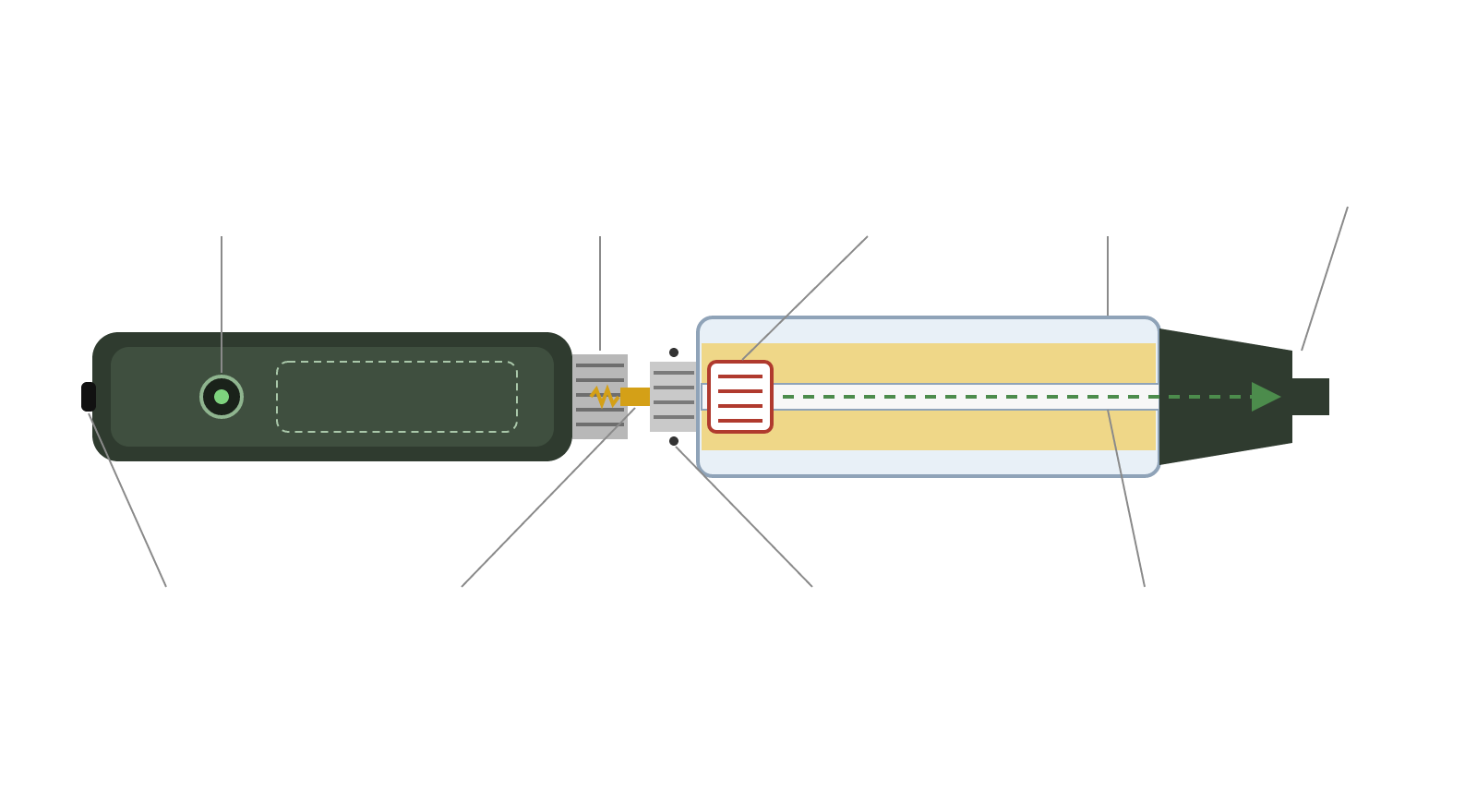
It's a bigger deal than it looks. According to Headset's category data, vapor pens are the second largest cannabis category in the US, cartridges and disposables average about $22 each, and the reusable battery is sold separately and sits outside those sales figures entirely. So that $22 of oil is riding on hardware most shoppers never think about.
Here's what each part of the connection does for you:
|
Part |
What it does |
Why you care |
|
510 threads |
Holds the cart, carries ground |
Cross-brand compatibility |
|
Center pin |
Carries the positive side to the coil |
A weak or fixed pin means misfires and "check connection" blinks |
|
Heating element |
Ceramic or wicked coil inside the cart |
The battery's voltage sets its temperature |
|
Airflow inlets |
Small holes in the cart base |
Blocked inlets are the usual cause of a hard draw |
|
Voltage setting |
Set on the battery |
Controls flavor, harshness and cart life |
The 8 Specs That Actually Matter
Spec sheets for 510 batteries list a dozen things. Only about eight of them change your experience. Here they are in order of importance.
If you only read one, read the first. Voltage control is where a $30 battery earns the extra $20 over the one by the register.
1. Variable Voltage: Why "Start Low" Isn't Just a Cliché
Voltage is the battery's throttle. More voltage, hotter coil, bigger cloud, harsher hit, faster cart burn.
A fixed 3.2V or 3.6V pen runs every cart hot, whether it's a delicate live rosin or a thick winter-stiff distillate. A variable voltage battery lets you pick.
Here's the part most guides skip. Heat doesn't just change taste. Researchers at Portland State University vaped a synthetic THC and terpene oil at different power levels and tracked what came out. In their 2021 paper in RSC Advances, they found levels of the main degradation byproducts were "highly correlated with applied power," which is a polite way of saying the hotter you run a cart, the more of that stuff you inhale.
So the low setting isn't a flavor-snob setting. It's the default.
|
Voltage |
What you'll notice |
Best for |
|
2.4V to 2.8V |
Light vapor, full flavor, cool draw |
Live resin, live rosin, terpene-heavy carts |
|
2.9V to 3.3V |
Balanced vapor and taste |
Most distillate carts, everyday use |
|
3.4V to 3.8V |
Dense clouds, warmer throat hit |
Thick or cold oil, stubborn older carts |
|
3.9V and up |
Burnt taste risk rises fast |
Wax atomizers, not oil carts |
One caveat: some batteries show a "temperature" on a screen. On a 510 battery that number is a voltage label with a different font. It isn't measuring anything. Treat it as low, medium, high.
2. A Preheat Mode That Actually Works
Distillate thickens when it's cold. If you've ever pulled on a cart in January and got nothing, that's why.
Preheat runs the coil at a low voltage for 10 to 15 seconds before you draw. It loosens the oil and saves you from cranking the voltage up to force a hit.
Use it when:
-
The cart has been sitting in a cold car or a coat pocket
-
It's the first draw after a few days of storage
-
The draw is tight and you suspect a minor clog
-
You're on a fresh cart and the wick hasn't saturated yet
Two clicks of the button is the common trigger. What's the bottom line here? If a battery doesn't list a preheat function, assume it doesn't have one and keep shopping. Full-spectrum oils and distillates behave differently at cold temperatures, and Leafythings breaks down how distillate and fuller-spectrum oils differ if you want to match your cart type to your settings.
3. Button or Draw-Activated? Choose for Your Hands, Not the Hype
Draw-activated (buttonless) batteries fire when you inhale. Button batteries fire when you press.
Neither is "better." They solve different problems:
-
Draw-activated has zero learning curve, looks like nothing in your hand, and is the right pick if grip strength or finger dexterity is an issue. The trade-off is that most are fixed voltage with no preheat.
-
Button-activated gives you voltage control, preheat, and a 5-click on/off lock. The trade-off is a slightly bulkier body and one more thing to learn.
That 5-click lock deserves its own sentence. The U.S. Fire Administration's report on e-cigarette fires and explosions counted 195 incidents between 2009 and 2016, and 61 of them, or 31%, happened while the device or a spare battery was in a pocket. A locked button can't fire against your keys.
4. Capacity in mAh (and the Weight Trade-Off Nobody Mentions)
Milliamp-hours tell you how much charge the cell holds. More is better, right up until the pen weighs like a roll of quarters.
Slim pens run 280 to 350 mAh. Box-style and concealed batteries run 500 to 900 mAh or more. Here's how that maps to real life:
|
Capacity |
Light use (a few draws a day) |
Heavy use (30+ draws a day) |
Typical body |
|
280 to 350 mAh |
1 to 2 days |
Under a day |
Slim pen, 10 to 12 mm wide |
|
500 to 650 mAh |
2 to 3 days |
About a day |
Thicker pen or small box |
|
900 mAh and up |
3+ days |
1 to 2 days |
Box or concealed style |
One more thing about capacity. Lithium-ion cells don't love being drained to zero. Battery University notes that consumer Li-ion is typically rated for 300 to 500 full discharge and charge cycles, and that shallow, frequent charging is easier on the cell than deep discharges. Heat is the other enemy. A dashboard in July does more damage than a month of daily use.
5. USB-C Charging and the Protection Circuits Behind It
USB-C should be the baseline in 2026. Micro-USB ports wear out and the cables are disappearing. The old screw-on 510 chargers that came with early pens are worse still, because the charger, not the battery, decides when to stop.
But the port is the least important part of charging. What matters is what's behind it:
-
Overcharge protection stops the charge at a safe voltage instead of cooking the cell.
-
Short-circuit protection cuts power if a cart or cable shorts.
-
Draw time cut-off shuts the coil off after about 8 to 10 seconds. That's the "blinker." It's a safety feature, not a scoreboard.
-
Pass-through charging lets you use the pen while plugged in, which is convenient and, on a well-built battery, safe.
The USFA report found 25% of the incidents it tracked happened while a device was charging, and described the pairing of a vape with a lithium-ion cell as "a new and unique hazard." Charge from a standard USB port or a low-wattage adapter, not a 65W laptop brick, and not on a pillow.
Rule of thumb: if a listing says nothing about protection circuits, the honest reading is that there aren't any.
6. Certification: Look for UL 8139 on the Box
There is a safety standard for this exact product category. UL 8139 is recognized by ANSI and the Standards Council of Canada, and it puts a vaping device through the failures that actually happen in the real world.
The standard evaluates:
-
The electrical and battery management system as a whole, not just the cell
-
The heating circuit and how it responds to electrical stress
-
The charging system, including overcharge and incorrect-adapter scenarios
-
Mechanical integrity and containment in a worst-case lithium-ion failure
Most $9 batteries have never been near a UL lab. Some brands publish certification, some build to the standard without certifying, and plenty do neither.
Why does this matter for a $30 purchase? According to UL Standards & Engagement, more than half of e-cigarette and vape owners don't know their device is powered by a lithium-ion battery at all. The brand should know, and should be able to tell you what protections it built in.
7. Cart Fit: Diameter, Thread Depth, and Airflow
Every 510 cart screws onto every 510 battery. Whether it fits is another question.
Three things to check before you buy:
-
Diameter. Most 0.5 g and 1 g carts are 10.5 to 11.5 mm wide. 2 mL tanks run about 12 mm. A slim pen looks fine with a 10.5 mm cart and looks like a mushroom with a 12 mm one. Concealed batteries have a fixed cavity, so a fat cart may not close at all.
-
Thread depth. Carts vary in how far the thread post sticks out. A spring-loaded center pin absorbs that difference. A fixed pin is why some carts fire on one battery and blink on another. Finger tight is tight enough; over-tightening crushes the pin.
-
Magnetic adapters. Concealed and palm-style batteries often use a magnetic ring you screw onto the cart. They're handy and they get lost. Buy a battery that ships with spares.
If you want a sense of what's on shelves, Leafythings' roundup of cannabis vapes in Toronto shows how varied cart formats have become, from half-gram glass to 2 mL tanks.
8. Warranty, Support, and an Authenticity Check
A $9 battery is a disposable with extra steps. It dies in four months and you buy another.
A real warranty changes the math. The Kind Pen, a New Jersey hardware company that has been building vaporizers since 2011, sells most of its 510 thread batteries with variable voltage and preheat, builds in overcharge and short-circuit protection, and covers them with a lifetime warranty. Whether you buy from them or anyone else, that is the bar.
What "the bar" looks like on a product page:
-
Every protection circuit named, not implied by the word "safe"
-
A warranty term written down, with a way to claim it
-
A support email or phone number answered by a person
-
An authentication step for the device you received
The best part? A brand with a warranty also has a reason to fight counterfeits. Some publish authentication codes you can check online. Buy from the brand's own store or a listed retailer, because a fake battery is exactly the one that skipped every protection on this list.
3 Things That Matter Less Than the Packaging Suggests
Not every bullet on a product page deserves your attention. These three get more marketing than they've earned:
-
Colors, skins and "limited editions." Cosmetic. Pick what you like and move on.
-
Big screens showing a temperature. As covered above, a 510 battery doesn't measure coil temperature. A screen that says 425°F is showing you a voltage preset with extra steps.
-
1,000+ mAh in a pen body. Past about 650 mAh you're paying in weight, and a 1 g cart will be empty long before the cell notices.
Spend the money on voltage control and protection circuits instead.
New to All of This? Here's Where Dry Herb Vapes and Dab Pens Fit
A 510 battery powers oil cartridges. That's it. If you're holding flower or a jar of concentrate, you need different hardware.
Newer users mix these up constantly, and it leads to broken gear and bad first sessions. Here's the quick version of each.
Dry Herb Vaporizers Heat Flower Without Burning It
A dry herb vaporizer holds ground flower in a small oven and heats it to a set temperature, usually somewhere between 160°C and 220°C (320°F to 430°F). That's hot enough to release cannabinoids and terpenes as vapor, and below the point where the plant material combusts.
The science on this is solid. A 2016 study in PLOS One tested five commercial vaporizers and found the four electrically driven, temperature-controlled units converted at least 97.3% of the flower's THCA into active THC with no combustion. The one gas-powered unit in the test set the material on fire.
What to look for if you go this route:
-
True temperature control, in degrees, not "low/med/high"
-
Oven material: ceramic or stainless steel, not painted metal
-
Conduction vs. convection: conduction heats the oven walls (cheaper, faster), convection pushes hot air through the herb (more even, pricier)
-
Chamber size: most portables hold 0.1 g to 0.3 g, so an eighth lasts a while. Leafythings has a plain-English guide to weed measurements if grams and eighths are new to you.
-
Cleaning: removable screens and a mouthpiece you can soak in isopropyl alcohol
Dab Pens and Wax Atomizers Are Built for Concentrates
A dab pen is a battery with a heating chamber you load yourself. You place a small amount of wax, shatter, budder or rosin directly on the coil, and it vaporizes on contact.
The coil is the whole product here:
|
Coil type |
How it hits |
Best for |
|
Quartz rod |
Fast, big vapor, less flavor |
Wax, shatter, crumble |
|
Ceramic |
Slower, more even, better flavor |
Budder, rosin, sauce |
|
Coil-less bucket or cup |
Cleanest flavor, easiest to clean |
Rosin and other solventless |
Here's the thing most beginners don't know: many 510 batteries also accept a 510 wax atomizer. Screw the oil cart off, screw the atomizer on, and the same battery now handles concentrates. It's the cheapest way to try dabs, as long as your battery reaches the higher voltages wax coils want (usually 3.4V to 4.0V) and has a preheat.
Two cautions before you do:
-
Potency. Concentrates usually test between 60% and 90% THC, versus 15% to 30% for flower, so the same-sized draw is a very different experience.
-
Maintenance. A loaded coil needs cleaning after every few sessions or it tastes like a campfire.
If you're brand new, get comfortable with a cart at low voltage before you buy a jar.
Which One Should a New User Buy First?
If you're deciding between the three, this table settles most of it:
|
510 battery + cartridge |
Dry herb vaporizer |
Dab pen |
|
|
What you load |
Pre-filled oil cart |
Ground flower |
Concentrate |
|
Learning curve |
Lowest |
Moderate |
Moderate to high |
|
Upfront cost |
$10 to $60 for the battery |
$50 to $300+ |
$30 to $150 |
|
Cleaning |
Almost none |
After every session |
After every few sessions |
|
Smell |
Minimal |
Noticeable while in use |
Minimal to moderate |
|
Potency ceiling |
High |
Moderate |
Highest |
|
Start here? |
Yes, for most people |
Yes, if you already prefer flower |
Not first |
Whichever you choose, buy the oil or flower from a licensed shop. The CDC's EVALI investigation tied most of the 2,807 hospitalizations and deaths reported by February 2020 to THC vaping products from informal sources, with vitamin E acetate, a cutting agent used to thicken bootleg oil, strongly linked to the outbreak. A great battery can't fix a bad cart. Use the Leafythings dispensary map to find licensed options near you, and their strain directory if the names on the menu mean nothing yet.
The 60-Second Buying Checklist (Copy This to Your Notes)
Before you check out, confirm the listing says yes to each of these:
-
Variable voltage with a floor of 2.8V or lower
-
Preheat function
-
5-click on/off lock (button models)
-
USB-C port with overcharge and short-circuit protection named on the page
-
Auto shut-off after 8 to 10 seconds of firing
-
Spring-loaded center pin
-
Fits your cart width (10.5 to 12 mm) and, for concealed styles, ships spare magnetic rings
-
UL 8139 certification or, at minimum, the protections above stated in writing
-
A warranty longer than the cart you're buying it for
-
Sold by the brand or a retailer the brand lists
Ten yeses and you're done. Anything with three or more "not mentioned" answers goes back on the shelf.
Frequently Asked Questions
Does every 510 cart work with every 510 battery?
Electrically, almost always. The threading and pin are standardized.
Physically, check the width. A 12 mm 2 mL tank may not close inside a concealed battery built for 10.5 mm carts, and a few draw-activated pens don't push enough current for thick oil.
What voltage should I use for distillate versus live resin?
Start distillate around 3.0V and live resin or rosin around 2.5V, then move one step at a time.
If it tastes burnt, you've gone too far. If you get nothing, run preheat before you raise the voltage.
Why does my battery blink 10 times and stop?
Either you held the draw past the cut-off (usually 8 to 10 seconds) or the battery isn't making contact with the cart.
Unscrew the cart, clean the threads and the pin with a dry cotton swab, and reseat it finger tight. If it still blinks with a different cart, the pin is the problem, not the oil.
Is a dry herb vaporizer "better" than carts?
Different, not better. Dry herb gives you flower's full profile and real temperature control. Carts give you convenience and consistency with almost no cleaning.
Plenty of people own both and reach for each on different days.
Pick the Battery First, Then the Cart
The cart is the consumable. The battery is the tool you'll still be using a year from now, so it deserves the twenty minutes of thought most people give the cart.
Buy the battery like you'll own it for years. Buy the cart like you'll finish it this month.
Variable voltage, preheat, a lock, USB-C with real protection circuits, and a brand that stands behind it. That's the list. Everything past that is taste.
Now it's your turn. Which 510 battery are you running, and what voltage do you actually use day to day? Drop it in the comments, because the best setting for a live rosin cart is still a running argument. If this guide saved you from buying another gas station pen, share it with the friend who keeps borrowing yours. And when you're ready to pair that battery with something worth vaporizing, the Leafythings map shows licensed dispensaries and delivery services near you.
Related Posts
/fit-in/1024x1024/storage/images/d949c0f7-0e36.jpg)
/fit-in/1024x1024/storage/images/922ddff7-96b4.jpg)
/fit-in/1024x1024/storage/images/dcb65276-e01a.jpg)
/fit-in/1024x1024/storage/images/f4f913f1-34a4.jpg)
/fit-in/1024x1024/storage/images/8d9100c5-aec5.jpg)
/fit-in/1024x1024/storage/images/735afddb-8058.jpg)
/fit-in/1024x1024/storage/images/b98f3ad4-952e.jpg)
/fit-in/1024x1024/storage/images/918ca617-7ebe.jpg)
/fit-in/1024x1024/storage/images/ed20bb9a-a575.jpg)
/fit-in/1024x1024/storage/images/1a2c27dc-9d76.jpg)
/fit-in/1024x1024/storage/images/9af15906-d6f5.jpg)